
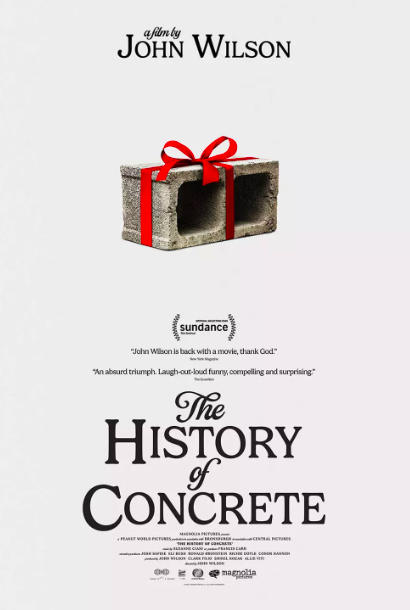
Do you ever think about concrete?
No. Of course you don't. Nobody does. It's under your feet right now, it's holding up the building you're in, it's the most widely used building material on the planet, and you have never once thought about it on purpose.
John Wilson did. After three seasons of How To with John Wilson on HBO, the show where he turned scaffolding, risotto and small talk into some of the most moving television of the decade, he decided his first feature film would be the definitive documentary about concrete. The History of Concrete premiered at Sundance this year and hit cinemas in September.
Then he ran into the problem every storyteller runs into sooner or later. He realized nobody would sit through 100 minutes about concrete.
So he did something brilliant and slightly unhinged. He signed up for a workshop on how to write and sell a Hallmark movie. Yes, those Hallmark movies: the small town, the big-city woman, the handsome local guy, the Christmas miracle. And he tried to apply the formula to a documentary about cement.
The film that came out of it isn't really about concrete. It's about the Pantheon in Rome, whose concrete dome is still standing after almost two thousand years. It's about the first concrete street in America, in a small town in Ohio, patched over and over and still cracking. It's about a guy who runs a company that removes chewing gum from New York sidewalks. It's about a convention where scientists explain we'll need concrete on Mars. And it's about a filmmaker trying to make something people will actually want to watch.
Which, if you think about it, is the only story any of us are ever telling.
What concrete teaches us
There are no boring subjects. Only boring angles. Concrete is a terrible topic. Concrete as the thing a lonely filmmaker uses to understand his city is a great one. The subject never changes. The way in does. Wilson didn't make concrete interesting by explaining it better. He made it interesting by finding the people standing on it.
Structure isn't the enemy of art. It's easy to laugh at the Hallmark formula. Wilson didn't. He took it seriously, because it works: someone wants something, something stands in the way, something changes. A cheesy Christmas movie and a Sundance documentary run on the same engine. The difference is what you put inside it.
The struggle is the story. The most honest thing in the film is Wilson admitting, on camera, that his idea might not work. That's the moment audiences lean in. People don't connect with perfect. They connect with someone trying, failing, and trying again in a slightly different way.
Get lost on purpose. Gum removal. Tattoo preservation. Concrete on Mars. Critics have called the film random, and that's the point. The detours are where the life is. A story that only goes in a straight line feels like a brochure.
Make the audience see what was always there. The real trick of the film is that you walk out of the cinema and suddenly notice every crack in the pavement. Good storytelling doesn't add anything to the world. It changes how you look at it.
Every brand is concrete
Here's the uncomfortable truth for anyone who makes things for brands. Most products are concrete. Useful, everywhere, essential, and something nobody will ever think about unless someone gives them a reason to.
A bank. An insurance company. A supermarket. A phone plan. Nobody wakes up wanting a story about them. And yet the work that lasts always finds the way in: the person, the city, the small absurd detail that makes the whole thing human.
That's the job. Not to make a boring thing look exciting, but to find the story that was already there, buried under the pavement, waiting for someone to look down.
Nothing is too boring to tell. It's just waiting for the right storyteller.